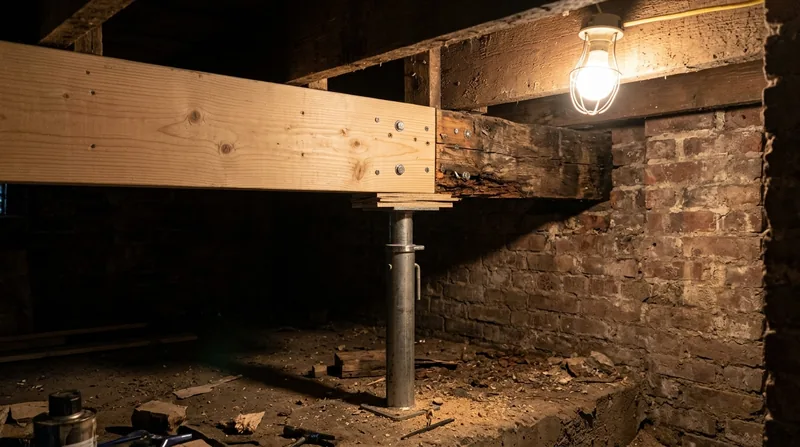




Floor Joist & Subfloor Repair in New York addresses a core problem in the city's older housing stock: sagging, bouncy, or soft floors that develop when wood framing rots in damp masonry pockets or weakens from decades of notching for utilities. New York's 1870s-1910s brownstones in Park Slope, Bed-Stuy, and Harlem, the wood-frame Victorians of Ditmas Park, and the brick rowhouses of Bay Ridge all sit on cellars and foundations that stay chronically damp through freeze-thaw cycles, nor'easter rain, and humidity. When sill plates and joist ends absorb moisture at the wet line where wood meets masonry, rot follows, and the floor structure fails. We sister compromised joists, replace sections of subfloor, and level floors before new finishes go down, restoring both safety and usability without unnecessary demolition. Our approach is to diagnose the water source, repair the wood that can be saved, and replace only what the damage justifies.
Why Floor Joist & Subfloor Repair Matters in New York's Older Homes
New York's residential buildings were constructed when building science didn't prioritize moisture management the way modern codes do. Sill plates rest directly on damp brick and rubble-stone foundations, joist pockets sit below grade, and party-wall beam ends penetrate into masonry that wicks water year-round. Winter freeze-thaw cycles crack mortar, spring and fall nor'easters drive rain through exterior walls, and summer humidity keeps cellars damp. Carpenter ants and eastern subterranean termites exploit this moisture, but the primary culprit is wood rot itself. A soft or bouncy floor is not just uncomfortable; it signals structural load transfer is compromised, and unaddressed rot accelerates across adjacent framing.
- Sill plates and joist ends in masonry pockets absorb groundwater and condensation, causing dry rot that weakens load capacity over decades.
- Plumbing, gas, and heating runs notched into joists during the 1950s-1980s reduced cross-sectional depth and created stress points where rot initiates faster.
- A sagging floor in a Brooklyn brownstone or Queens wood-frame house indicates active decay, not just age, and requires intervention to prevent further settlement.
- Water intrusion from exterior cracks, failed roof flashing, or blocked perimeter drainage must be stopped before repair begins, or new wood will rot the same way.
- Sistering joists or installing supplemental framing restores load capacity and levels floors without the cost and disruption of full joist replacement.
Addressing floor joist and subfloor damage early prevents settlement that cracks plaster, breaks windows, and compromises structural integrity across the entire house.
Key info: New York City building code and local enforcement vary by borough and community board. Structural work such as joist replacement or load-bearing alterations commonly requires a permit from your local Department of Buildings or equivalent authority. Contact your municipal building department to verify permit requirements before work begins. See NYC Department of Buildings for guidance specific to your address.
How We Repair Floor Joists & Subfloors in New York
Our process begins with a thorough inspection to identify which joists are compromised, where water is entering, and whether the damage is localized or systemic. We probe the wood to determine the depth and extent of rot, assess whether sistering (installing a new joist alongside the damaged one) is sufficient or if replacement is necessary, and examine the subfloor for soft spots or delamination. Once we understand the scope, we address the water source first, then install sister joists using through-bolts or lag screws, replace rotted subfloor sections with pressure-treated or kiln-dried lumber, and level the floor before finishes are restored. In a Park Slope brownstone or a Flatbush wood-frame house, this work is often done from below, accessing the basement or cellar to work on the underside of the framing.
- We inspect joists with a probe and moisture meter to identify the decay boundary and determine if the wood can be saved or must be replaced.
- We install sister joists using full-depth lumber bolted to the existing frame, restoring load capacity without removing the original member.
- We cut out and replace subfloor sections, using kiln-dried lumber and fastening with construction screws to prevent future movement and squeaking.
- We level the floor using shims, adjustable posts, or additional framing as the repair scope demands, ensuring the surface is true before finishes go down.
- We document the work with photos and notes to help you file an insurance claim if applicable, and we explain what caused the failure so you can prevent recurrence.
This methodical approach means your floor is sound, level, and built to last another century without the shock of full-scale demolition and reconstruction.
Local example: A Williamsburg loft with a sagging parlor floor turned out to have a rotted sill plate and two compromised joists where a plumbing line had been notched in the 1970s. We sistered both joists, replaced the sill plate pocket where it met the exterior masonry, sealed the exterior crack that had allowed water to enter, and leveled the floor. The work took five days and cost less than half the price of full joist replacement, and the floor has been solid for three years since.
Floor Joist & Subfloor Repair Methods
| Approach | Description | Best for |
|---|---|---|
| Sister Joist Installation | A new joist of matching depth is bolted alongside the weakened joist, distributing load across both members and restoring capacity without removing the original wood. | Joists with rot confined to the bottom 2-3 inches or notching that reduces depth but doesn't compromise the neutral axis. |
| Joist Replacement | The damaged joist is removed and replaced with kiln-dried lumber, often sistered or installed with temporary support during the transition to ensure no settlement. | Joists with rot deeper than 3-4 inches, severe notching, or damage at bearing points where sistering alone cannot restore full capacity. |
| Subfloor Patching & Leveling | Soft or delaminated subfloor sections are cut out and replaced, and the floor is shimmed and leveled to ensure a true, squeak-free surface for finish installation. | Localized subfloor damage, minor settlement, and squeaky floors that result from loose fastening or minor joist deflection. |
| Sill Plate & Pocket Repair | The deteriorated sill plate is cut out and replaced, and the masonry pocket is sealed to prevent future water infiltration and rot. | Rot that originates at the foundation line where the sill meets masonry, a common failure point in New York's older rowhouses and cellars. |
| Rim Joist & Band Board Replacement | The outer rim of the joist frame is replaced where it has rotted or been damaged by water entry, impact, or pest activity. | Exterior rim joists in contact with masonry, or band boards that have absorbed water from exterior walls, stoops, or porches. |
Each method is selected based on the extent of damage, the structural role of the member, and whether repair or replacement offers better long-term value. We always explain why we recommend one approach over another.
Floor Joist & Subfloor Repair Cost in New York: What to Expect
Floor joist and subfloor repair in New York typically starts at $1,800 for a localized repair such as sistering one joist and patching a small subfloor section. The cost rises with the number of joists affected, the extent of water damage, the difficulty of access from the basement or cellar, the need to address water intrusion at the source, and whether the work requires temporary support or shoring during installation. A full sill plate replacement in a brownstone cellar, or repair of multiple joists across a large parlor floor, commonly runs $3,500 to $8,000 or more. Structural work that requires a permit or engineering consultation adds time and cost. Getting 2-3 estimates from local carpenters allows you to compare scope, materials, and timeline, and to understand why one bid is higher or lower than another. Visit our pricing page for detailed breakdowns by repair type and scope.
Factors that move the cost:
- Number and length of joists to be repaired or replaced, and whether sistering or full replacement is necessary.
- Access difficulty: work from a finished basement costs less than work that requires opening up a parlor floor or cutting through plaster ceilings.
- Water source: if exterior cracks, failed flashing, or interior leaks must be sealed to prevent recurrence, that adds cost and time.
- Subfloor extent: patching 20 square feet is different from replacing 200 square feet of delaminated subfloor and leveling across the entire floor.
- Permits and inspections: if your local building department requires a permit for structural work, plan for inspection time and any design consultation.
We provide a free, no-obligation estimate within 24 hours of your call. Call (929) 493-3098 to describe the problem, and we'll schedule a site visit to measure, probe the wood, and give you a realistic price range.
Floor Joist & Subfloor Repair Near Me: What New York Homeowners Should Know When Hiring
Choosing the right carpenter for floor joist and subfloor repair requires more than a low bid. Look for a contractor who will spend time on site, probe the wood, explain what they find, and propose repair before replacement. Ask whether they understand the specific challenges of New York's building stock: damp cellars, masonry-embedded framing, and the freeze-thaw cycles that accelerate rot. Verify that they are fully insured and carry liability coverage for structural work. Request references from recent jobs in your neighborhood or borough, and ask to see before-and-after photos or to speak with a homeowner whose floor they've repaired. Understand whether your job requires a permit and whether the contractor will handle permit applications or defer to you. If your home is in a historic district or subject to a homeowners association, ask about any design or approval requirements before work begins.
- Get written estimates that itemize labor, materials, timeline, and any contingencies for hidden damage discovered during work.
- Ask the contractor to explain the water source and what steps will be taken to prevent the same rot from recurring after repair is complete.
- Verify that the contractor has experience with the specific joist species and framing style of your building (Victorian wood-frame, brownstone masonry pocket, etc.).
- Confirm whether permits are required for your project and whether the contractor will coordinate with the building department or leave that to you.
- Request proof of insurance and ask about their warranty on the repair work and the integrity of the leveled floor.
A reputable local carpenter will answer these questions clearly and will not pressure you into a decision. Contact us at https://nyc-carpentry.com/contact/ to discuss your floor and get a free estimate, or call (929) 493-3098 to describe the problem over the phone.
Floor Joist & Subfloor Repair in New York: Pricing Guide
| Service | Price | Details |
|---|---|---|
| Single joist sistering | Starting at $1,800 | Labor and materials to sister one joist with through-bolts, includes access and basic subfloor patching |
| Multiple joists and subfloor patching | Starting at $3,500 | Two to four joists sistered or replaced, subfloor section removed and replaced, floor leveled |
| Sill plate and pocket repair | Starting at $2,800 | Rotted sill plate replaced, masonry pocket sealed, includes exterior water intrusion assessment |
| Full floor repair with water source remediation | On estimate | Large-scale joist replacement, extensive subfloor work, exterior crack sealing, or permit-required structural work requires site inspection |
| Travel and estimate | Free | No charge for travel within New York and surrounding areas, free written estimate within 24 hours of your call |
Indicative pricing, the exact cost depends on square footage, finish, and site access. Free personalized estimate within 24h at (929) 493-3098.


