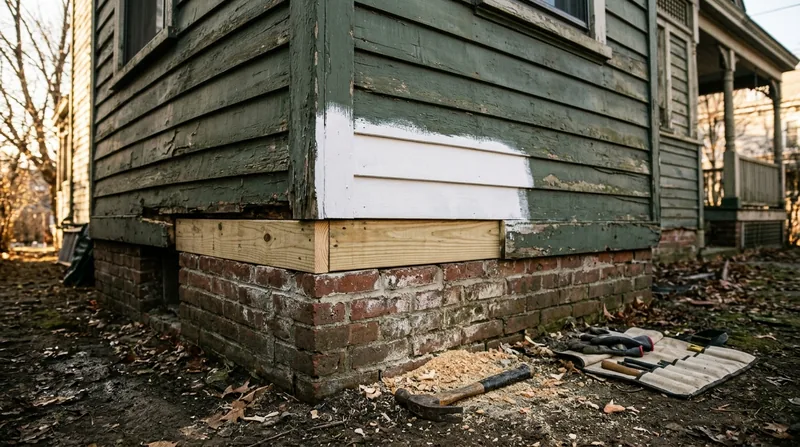




Wood rot and dry rot repair in New York is not a cosmetic fix. The nor'easter rains that drive moisture into Brooklyn brownstone sills and Queens frame-house rim joists demand permanent repair, not surface patching. New York's damp cellars, humid summers, and freeze-thaw cycles keep wood under constant attack. We cut out decayed framing, siding and trim, treat the surrounding wood, and rebuild with rot-resistant lumber. That is the only way to stop the decay and hold the structure sound.
The wood enemies in New York are water and time. A sill plate that sits at the wet line of a 1920s brick basement in Park Slope or a rim joist pocket in a Flatbush Victorian will soften year by year if moisture is not stopped and the damaged wood is not replaced. Carpenter ants follow that moisture. Eastern subterranean termites are active in the frame houses of Queens, Brooklyn and Staten Island. Stoops, cornices, window frames and original stair halls take the most abuse under low winter sun and wind-driven rain. The longer decay sits, the deeper it spreads, and the more framing has to come out.
We assess what can be repaired and what must be replaced. We do the work the same way every time, with the same carpenters on the job. We explain what we find and why the repair costs what it does. Call us at (929) 493-3098 for a free estimate, or read on to understand what wood rot repair actually involves in a New York home.
Why Wood Rot and Dry Rot Repair Matters in New York Brownstones and Frame Houses
New York's residential stock is old, and the climate is wet. Brownstone rowhouses in Park Slope, Prospect Heights, and Harlem were built in the 1870s through 1910s with sill plates and joist pockets sitting directly on rubble-stone or brick cellars that stay damp. Wood-frame Victorians in Ditmas Park and Flatbush, Tudor-style apartments in Jackson Heights and Forest Hills, and two-family frame houses across Astoria, Ridgewood and the Bronx all rely on wood framing that depends on staying dry. It does not. Nor'easters drive rain sideways into cornices and stoops. Salt air and winter freeze-thaw accelerate decay. Once rot starts, it does not stop on its own.
Decay spreads because moisture and wood-eating organisms are always present in New York. A soft spot in a sill plate or rim joist is not a small problem. It is a signal that the beam end or stud framing behind it is also compromised. If you leave it, the decay spreads into the band board, then into floor joists, then into the subfloor. The structural capacity of the house diminishes. Floors begin to sag. Door and window frames no longer hang square. The cost to repair grows exponentially.
- Moisture trapped in cellars and crawl spaces keeps wood wet and soft, allowing decay to accelerate year-round.
- Nor'easter rain and wind-driven moisture penetrate cornices, fascia, and exterior trim, especially on the north and west faces of buildings.
- Freeze-thaw cycles in winter split wood fibers and open cracks where water enters and decay takes hold.
- Carpenter ants and eastern subterranean termites exploit soft wood, creating galleries that weaken framing further.
- Original wood windows, door frames and stair stringers absorb water through paint cracks and glazing failures, leading to decay in high-value architectural elements.
Waiting for rot to go away is waiting for your house to fail. Early repair saves money and preserves the structure.
Key info: A sill plate or rim joist showing soft wood or active decay in a Park Slope brownstone or Bay Ridge rowhouse typically requires sistering new framing alongside the damaged section or full replacement of the affected member. The longer decay sits, the more wood has to come out, and the higher the cost. Early inspection and repair are always cheaper than waiting.
For more information on related structural damage, see our guide to termite damage repair in New York, which often accompanies wood rot in frame houses and older masonry structures.
How We Repair Wood Rot and Dry Rot in New York Homes
Our process is straightforward: we identify the extent of decay, remove all soft wood, treat the sound wood around it, and rebuild with materials that will not rot again. We do not patch over rot or use cosmetic fillers. We cut it out. We work from moisture sources outward, so the repair lasts. On a brownstone stoop in Harlem or a frame house in Freeport, the steps are the same.
The first step is always diagnosis. We probe the wood with a screwdriver or awl to find the boundary between sound and decayed material. We identify where moisture is entering and whether the damage is active or old. We look at the structural role the member plays and whether it can be repaired or must be replaced. On a load-bearing sill plate or beam, this assessment is critical. On trim or non-structural fascia, repair is often possible.
Once we know the scope, we remove the decayed wood completely. We cut back to solid material on all sides. We treat the exposed sound wood with a borate solution or wood preservative to prevent future decay. Then we rebuild using pressure-treated lumber, naturally rot-resistant species like redwood or Douglas fir heartwood, or composite materials rated for exterior exposure. The new wood is fastened securely to the existing framing and finished to match the original.
- We inspect the damage zone with hand tools and a moisture meter to determine the extent of decay and the source of moisture.
- We remove all soft, decayed wood using chisels, saws and pry bars, cutting back to firm material on all edges.
- We treat the exposed sound wood with a wood preservative to arrest decay and prevent future infestation.
- We fabricate and install replacement framing, siding, trim or structural members using rot-resistant lumber and proper fastening.
- We finish the repair to match the existing material, color and profile so the work integrates seamlessly.
- We address the moisture source: sealing leaks, improving drainage, or installing flashing so the repair does not fail again.
The entire process is permanent because we remove the problem and build with materials that resist it. A sill plate repair in a Park Slope basement or a stoop fascia repair in Sunset Park will hold for decades if moisture is kept out.
Example: A brownstone in Prospect Heights with a rotted stoop rail post and fascia board. The post was soft to the awl 6 inches down from the top. The fascia behind it was completely decayed where water ran off the cornice. We cut out the post to 12 inches below the damage, installed a new pressure-treated post with a stainless steel fastener at the base, and replaced the fascia with primed and painted redwood. The stoop is solid again, and the repair will last 30 years if the roof flashing stays tight.
For complex structural repairs involving floor joists or rim joists, see our detailed service page on floor joist and subfloor repair in New York.
Wood Rot and Dry Rot Repair Methods
| Approach | Description | Best For |
|---|---|---|
| Selective removal and replacement | Cut out only the decayed section of a member, treat the remaining sound wood, and install new material using sistering or full-depth replacement. | Sill plates, rim joists, fascia boards, window frames and trim where the decay is localized and the member can be partially saved. |
| Full member replacement | Remove the entire damaged member and install a new one, typically used when decay is extensive or the member is non-structural. | Stoop posts, porch beams, door jambs, fascia runs and stair stringers where decay spans more than one-third of the member. |
| Sistering with sister boards | Install new framing alongside a damaged beam or joist, fastened securely to share the load and restore structural capacity. | Load-bearing sill plates, floor joists and beams in basements where the original member is partially decayed but still in place. |
| Moisture control and preservation treatment | Seal leaks, improve drainage around the repair zone, and apply wood preservative to exposed sound wood to prevent future decay. | All repairs, especially in damp basements, under cornices, around windows and on exposed stoops where water entry is the root cause. |
The method we choose depends on the location of the decay, the structural role of the member, and the extent of damage. We always prefer repair over replacement when the wood justifies it, because repair is faster, cheaper and preserves the original fabric of the house. On a 1920s joist or a historic stair stringer, repair is always the first choice.
Wood Rot and Dry Rot Repair Cost in New York: What to Expect
The cost of wood rot repair in New York depends on what has to come out and what has to go back in. A small rot repair on trim or fascia, where decay is shallow and localized, can start at $650. A sill plate repair in a basement, where you are working in a confined space and the member is load-bearing, typically runs $1,500 to $3,500. A full stoop post and fascia replacement in a brownstone front can run $2,500 to $5,000. Extensive floor joist or rim joist replacement in a Queens frame house can exceed $8,000.
The factors that move the price are straightforward. How much wood has to come out? Is the member load-bearing, or is it trim? Can you access it easily, or are you working in a confined basement or behind existing finishes? How much of the surrounding material has to be disturbed? Do you need a structural engineer to sign off on the repair? Is the original material a historic wood species that has to be matched? How long does the job take?
A small rot spot on a cornice fascia in Park Slope, where you can reach it from a ladder and the decay is surface-level, is a one-day job and costs less. A rotted sill plate under a load-bearing wall in a Harlem brownstone basement, where you have to shore the wall, remove plaster and masonry, cut out the beam, install a new one, and make good the wall, is a three- to five-day job and costs more.
The only way to know the real cost is to have us look at it. We give free estimates within 24 hours of your call. We measure, probe, and assess the scope. We tell you what has to come out, what it will take to fix it, and what it will cost. We also tell you if a structural engineer or a permit is needed. No surprises. For a detailed pricing breakdown and examples, see our full pricing page.
Getting 2 or 3 estimates is always smart. You will learn whether the decay is as bad as you think, whether repair or replacement makes sense, and whether the price is fair. Call us at (929) 493-3098 to schedule yours.
What to Look for When Hiring a Carpentry Contractor Near Me in New York
When you are looking for a carpenter to repair wood rot near you in New York, you are hiring someone to cut into the structure of your house and rebuild it. That is not a casual choice. You need a contractor who understands the building stock, who has done this work before, and who will explain what they find and why the repair costs what it does.
First, confirm that the contractor is fully insured. Ask for a certificate of insurance and verify that it covers the work you are hiring them for. Second, ask for references from homeowners in your neighborhood. A contractor who has repaired rotted sill plates in Prospect Heights brownstones or frame houses in Freeport has seen the problems that are specific to those buildings. Third, get multiple estimates. You are not looking for the lowest price; you are looking for the estimate that explains the most clearly what is wrong, what has to come out, and why the repair is the right answer.
Fourth, ask whether a permit is needed. In New York, permits are commonly required for structural work such as replacing beams, joists or load-bearing members, and requirements vary by community. Your contractor should know this and should tell you to contact your local building department to verify. If a permit is required, a reputable contractor will not avoid it. Fifth, ask about the warranty or guarantee on the work. A permanent repair should come with a commitment that it will not fail if moisture is kept out. Sixth, check whether the contractor has experience with the specific building type and materials in your home. A brownstone needs different knowledge than a frame house. An 1920s joist is not the same as a 1980s beam.
Finally, trust your instinct about communication. A good contractor listens to your concerns, explains what they find in plain English, answers your questions, and does not pressure you to decide on the spot. If something does not feel right, get another estimate.
For a free estimate and a conversation about your repair, contact us online or call (929) 493-3098. We respond within 24 hours and never charge for the initial assessment.
Wood Rot & Dry Rot Repair in New York: Pricing Guide
| Service | Price | Details |
|---|---|---|
| Small trim or fascia rot repair | Starting at $650 | Localized decay on non-structural fascia, cornice trim or window frame; includes removal, treatment and replacement with rot-resistant lumber |
| Sill plate or rim joist repair | Starting at $1,500 | Load-bearing sill or joist with localized decay; includes sistering or partial replacement, moisture treatment, and securing to existing structure |
| Stoop post, porch beam or full member replacement | Starting at $2,500 | Complete removal and replacement of a structural or semi-structural member; includes new material, fastening, finishing and integration with existing work |
| Extensive floor joist or rim joist replacement | Starting at $5,000 | Multiple joists or large beam replacement in basement or crawl space; includes shoring, removal, new framing, treatment and structural restoration |
| Travel | Included | No separate charge for travel within New York and surrounding areas; mileage is included in the estimate |
| Free estimate | Free | On-site assessment with moisture meter and hand probe; response within 24 hours at (929) 493-3098; no obligation to book |
Indicative pricing, the exact cost depends on square footage, finish, and site access. Free personalized estimate within 24h at (929) 493-3098.


